

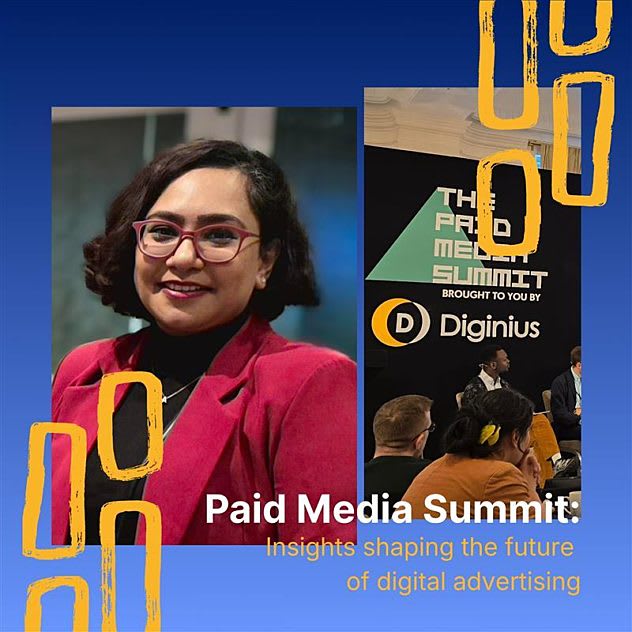
The MTM Agency Paid Media Manager Alavi Sumaia shares the key themes and takeaways shaping the future of digital advertising.
The Paid Media Summit 2026, hosted in London and sponsored by Diginius and Swydo, brought together leaders from across the digital landscape - including Microsoft Advertising, TikTok, Canva, and a range of forward‑thinking agencies. The MTM Agency’s Paid Media Team joined a wide range of practitioners and strategists to explore the radical shifts happening across AI, search, media investment, strategy, and client relationships.
Across panels, presentations, and informal conversations, one message rang clear: paid media is undergoing its most transformative era since the birth of digital advertising. Below, we break down the themes that will shape the next wave of performance marketing.
AI is redefining the entire paid media workflow
No surprise, conversations around AI were everywhere. Automation is accelerating far beyond bid strategies and is now influencing how platforms understand content, predict intent, rank products, and personalise ads.
Speakers emphasised that AI is now responsible for much of what historically required human optimisation:
Campaign setup and management
Creative iteration
Bidding and audience targeting
Cross‑channel optimisation
Product feed interpretation
This shift places new importance on the inputs we provide platforms - creative quality, data consistency, structured content, and cross‑channel signals. Rather than “button‑pressing,” the role of paid media managers is shifting toward strategic direction, creative excellence, and model training.
You can read more on how creative diversity and intelligent iteration are redefining performance in our blog on the Meta Andromeda update.
AI search is rising fast, and content needs to adapt
One of the standout insights was that AI‑led search could account for up to 50% of searches by 2028. With AI Overviews, conversational engines, and agentic commerce to consider, the default is no longer the traditional blue‑link SERP.
Businesses must now optimise for AI‑driven content selection, not just keyword relevance. The key requirements:
Clear structure: Descriptive titles, strong H1s, chapter‑style headings
Snippable content: Bullets, Q&A formats, tables - formats AI can lift cleanly
Natural language clarity: Semantic optimisation, not keyword density
Accessibility of information: Content hidden behind tabs, images, or PDFs is often ignored
Schema markup: Structured data that helps AI understand context
The takeaway from this is that SEO, paid media, brand, and content teams now need to collaborate more closely than ever to ensure visibility across AI‑powered search surfaces. It is a tangible endorsement of an integrated approach to paid advertising.
Measurement remains a major industry challenge
Despite advances in automation, attribution continues to frustrate marketers.
With privacy changes, reduced tracking visibility, and increasingly complex multi‑touch journeys, many agencies and brands struggle to gain reliable performance clarity. Speakers highlighted:
Limitations in cross‑platform attribution
Gaps in feed quality affecting performance
Legacy data structures are slowing down modern retail and e-commerce
The increasing importance of product data health in AI recommendation systems
A powerful insight emerged: in AI‑driven shopping environments, the quality of your product data matters more than the size of your ad budget.
In other words, brands that prioritise strong data infrastructure and clean, consistent product feeds will be the ones rewarded by recommendation engines and platform algorithms.
Creative is becoming the new performance driver
As platforms automate more optimisation tasks, creative quality has become one of the biggest differentiators in campaign performance.
Discussions from TikTok, Canva, and several agencies highlighted the shift toward:
Faster creative production and iteration
More asset variety to improve machine learning training
Native storytelling formats across channels
Creative testing with proper structure and intent
Paid advertising specialists need to change their mindset from creative assets being ‘supporting’ to core performance levers.
Diversification has become a necessity
The summit reinforced that relying solely on Google Ads is increasingly unsustainable.
There’s a clear movement toward:
Microsoft Advertising (boosted by Copilot and new AI-driven surfaces)
TikTok as a discovery and intent‑shaping platform
Programmatic and retail media
A broader view of the funnel and channel mix
Each platform serves a different purpose, and so diversification allows you to create a unified strategy.
Client relationships still matter the most
As conversations around automation and AI dominated much of the summit, another theme served as an important counterbalance: the continued value of human connection. One of the most memorable sessions explored how agencies risk losing clients by neglecting simple principles: communication, transparency, and trust. It's important to remember:
Clear, jargon-free communication is essential
Clients value honesty and proactive guidance
Strong relationships remain the foundation of long-term partnerships
Even in an AI‑first world, human connection and clarity remain irreplaceable
This theme echoed across panels. While AI may transform the work, people still define the experience.
A shift worth embracing
The Paid Media Summit 2026 highlighted that paid media is undergoing a transformation, which is challenging, but exciting. The discipline is being rebuilt around data integrity, creative agility, and cross‑channel intelligence.
The pace of change will continue, but agencies that embrace experimentation, invest in data and creative, diversify their channel mix, and maintain strong relationships will be the ones leading the next era of digital performance.
Let’s shape the next era of paid media
Want to explore how these insights could shape your paid media strategy? Get in touch with our team to start building smarter, AI‑ready campaigns.