


By Wes Maynard, Managing Director, The MTM Agency
Over the past couple of years, AI content has become increasingly appealing to marketers. It makes content production quick and easy and, in theory, allows websites to compete for rankings through sheer volume and coverage. Early concerns about the risks quickly gave way to widespread acceptance, with AI content seen as an SEO ‘hack’, especially when Google’s guidelines appeared, for a short time, to endorse it.
Against that backdrop, a huge surge of AI-generated content flooded the internet, and only recently have the reality and consequences started to emerge.
AI content, in my view, has never been ‘good’ for SEO. Google's current search algorithm has tolerated AI-generated content that offers some usefulness, but that, as I’ll outline in this article, is changing.
Websites that have run head-first into the AI-content boom and scaled their content production intensely are already starting to see some negative effects under the current search algorithm. And some very well-informed people are predicting that AI content is about to be punished in a major algorithm update, and all the signs are there that the tide is turning. Marketers, therefore, need to be prepared to radically switch course before this happens.
The AI content ‘gold rush’
Lily Ray, one of the most respected voices in SEO, has talked recently about the ‘cycle of SEO’ which refers to the pattern of surge-boom-crash which happens when SEOs discover, publicise and implement a perceived ‘growth hack’.
In many cases, the search engine and now AI search engines crack down and build systems to stop these tactics from working in the form of algorithm updates or new policies. There is a retrospective punishment of content produced in that way, and SEOs have to find new ‘get rankings fast’ methods…so the cycle continues.
This is exactly what is already happening with AI content.
The ‘AI content gold rush’ has been fuelled by some generously interpreted guidelines from Google over the past few years. According to Google’s current official guidance, content is evaluated based on quality rather than how it was created, and the focus is on material being helpful, original and accurate. This, alongside the fact that in the September 2023 Helpful Content Update Google removed the words ‘written by people’ from its guidance and replaced them with ‘helpful content created for people’, meant people assumed Google was endorsing AI content. However, it's clear now that this was a red herring.
Six months later came the scaled content abuse policy, and everything since has indicated the opposite stance, suggesting we are approaching the ‘crackdown’ stage of the cycle of SEO.
The warning signs that a major crackdown is coming
Before every major algorithmic update, there have always been warning signs in Google’s official guidance and messaging, which Lily Ray covers in more detail in this recent article.
Within the last two years, there have been many of these warning signs pointing to the fact that a major change is on the horizon:
In an update to Google’s guidance on AI content in October, it is now stated as ‘critical’ to manually fact-check AI-generated content
Google now explicitly points publishers using AI towards sections covering scaled content abuse and content created with ‘little effort, originality or added value’.
In October 2026, Google substantially expanded its Helpful Content documentation, explicitly defining ‘Main Content’ and highlighting factors such as effort, originality, skill, experience and accuracy. As Marie Haynes notes, these are the qualities Google's machine learning systems are designed to reward, while mass-produced content created with little human input becomes increasingly vulnerable.
Fake authors are now officially recognised by Google as a form of deception.
The frequency of spam updates by Google is increasing, with 4 already in 2026 versus just one in 2025.
Google has warned against seeking inauthentic mentions.
Google representatives are speaking about it in public. An example is that at a recent Google Search Central Live event in Barcelona, Google analyst Gary Illyes claimed that ‘scaled content is now becoming more of a problem than link spam’.
These warning signs have built up, leading many Google algorithm analysts to the conclusion that a big change is coming.
According to the data, it’s happening already
The evidence against AI content is already stacking up. A Semrush analysis from earlier in the year of 42,000 blog pages and 20,000 keywords found that although AI-assisted content can rank, position-one results were eight times more likely to be human-written than content identified as purely AI-generated. That is, AI content can perform, but genuinely original content still dominates where it matters most.
There are two reasons for this.
The first is that the content AI produces often goes against the guidelines Google has long had for useful content. These shortfalls include generic recommendations, a lack of unique insight and generic repeated phrasing and structure.
Recent updates to Google's Helpful Content documentation help explain why. Google has added explicit references to content effort, originality, skill, experience and accuracy, while also introducing guidance around deceptive authorship. Marie Haynes argues these guidelines matter because they reflect the characteristics Google's machine-learning ranking systems are being trained to recognise and reward.
The second reason is that, as discussed above, over the last couple of years, Google's spam updates have incrementally moved toward actively penalising AI-generated content, regardless of writing quality. Instead, they're weeding it out using indicators like aggressive content scaling, inauthentic mentions, and self-promotional tactics like listicles aimed at ranking in AI-generated search.
This active penalisation will only get more widespread and thorough, especially if the early results of Google’s latest spam update (from September 2026) are anything to go by.
Research by Lily Ray shows a drastic loss in rankings immediately after the launch for domains with highly templated, programmatic (likely) AI-generated pages, like one page for every phone number or area code.
The graph below is an example she cites.
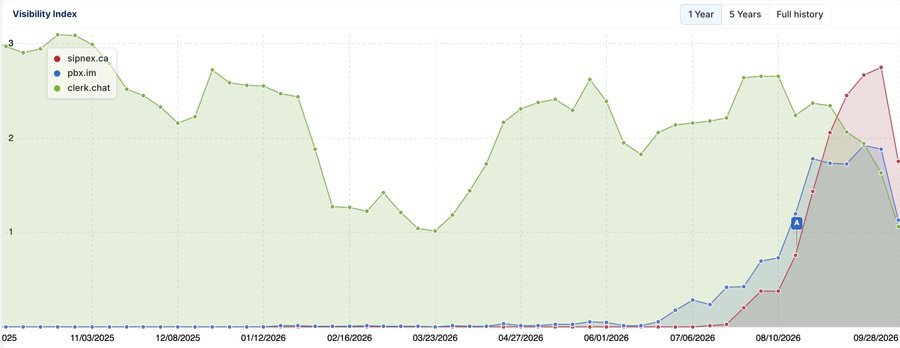
Each line represents a separate business communications company domain, which appears to rely on AI for its high-volume content. You can see an immediate drop-off in rankings from the September spam update for each of the domains.
As discussed above, Lily Ray has predicted an even bigger swing away from AI-generated content, which could leave those who jumped on the AI content gold rush bandwagon initially with tanked rankings and needing to start again from scratch.
Glenn Gabe, another well-respected Google algorithm analyst, has been documenting similar patterns throughout Google's recent spam updates. During the September 2026 spam update, he published regular ‘Spam Update Notes’ highlighting sites affected by the rollout, while his analysis of the August 2026 spam update identified scaled, programmatic, AI-generated and thin affiliate content amongst the types of content being impacted.
Following Google's latest documentation updates around AI-generated content, scaled content abuse and deceptive authorship, Gabe warned, ‘For those still wanting to scale via AI or programmatic content, Google is clearly trying to tell you something.’ He later added that, based on the documentation changes and Google's public messaging over the past year, ‘we are going to see a very big update from Google.’
Whether or not that prediction proves correct, it reflects a growing consensus among experienced SEO practitioners that Google's direction of travel is becoming increasingly difficult to ignore.
Google's watermarking technology should be a warning sign
Another interesting development is Google's investment in SynthID.
SynthID is Google's watermarking technology designed to identify AI-generated content across images, audio, video and increasingly text. It works by embedding signals directly into generated outputs that are imperceptible to humans but detectable by Google's systems.
To be clear, Google has not announced that SynthID is being used as a ranking factor, and there is currently no evidence that it directly affects rankings.
What's particularly telling is that this isn't happening in isolation. In August 2026, Anthropic announced that future Claude models will also include text watermarking using a version of Google DeepMind's SynthID-Text technology. The move was introduced to comply with the EU AI Act and follows a broader industry commitment to label and identify AI-generated content. Anthropic stressed that these watermarks are invisible to readers, don't affect output quality and contain no user-identifying information, but they do enable organisations to determine whether AI was involved in creating a piece of content.
That's significant not only for SEO, but for GEO (Generative Engine Optimisation) too. As AI-powered search experiences become more common, visibility will increasingly depend on whether AI systems view a brand as a credible source worth citing and referencing
When the most powerful technology companies are investing significant resources into identifying AI-generated content, the question has to be asked: why?
This development supports the claim that more active measures to penalise AI-generated content are on the way both within search engine ranking and within AI-mediated citations.
The better alternative
When generative AI first arrived, the prevailing view was that search engines wouldn't care. As long as the content answered the question, it would rank. Many organisations took that as permission to scale content production aggressively, filling their websites with AI-written pages at a speed that would have been impossible just a few years ago. But evidence from Google updates, SEO research, and publishers' experiences tells a more complicated story.
Right now, Google's official stance is that it isn't targeting AI content simply because it was created by AI. However, the evidence suggests it is getting much better at identifying and devaluing the characteristics that often come with large-scale AI publishing: repetition, lack of originality, shallow expertise, and content that exists primarily because somebody wanted another page on their website.
More alarming for content producers is what may be coming down the track: a more targeted approach to penalising AI content, regardless of quality.
It's particularly important as GEO (AEO to some) becomes a larger part of the marketing conversation. Brands are understandably interested in how they appear in AI-generated answers, but many are making the mistake of throwing more AI-generated content at the problem.
The evidence suggests the opposite approach may be more effective. The brands most likely to earn visibility in AI search are the ones demonstrating genuine expertise, original thinking and real authority, not simply publishing at the greatest volume.
This being said, at MTM we 100 per cent support the advantage agentic efficiency offers. AI is fundamentally re-wiring the digital marketing playbook, and it can certainly play a role in producing quality content. But strip out human judgement? Google can tell. Increasingly, so can AI-powered search engines.
Creating content that matters
At MTM, our content marketing team combines creative and strategic thinking with intelligent technology to deliver quality content that supports both your brand’s reputation and search visibility.
We have our own internal system, QuickQuill, which uses agentic support individually trained on isolated, secure knowledge bases about our clients to help us create and define briefs, research, structure, analyse, and fact-check. The difference? Our adept human writers are at the core of this proprietary AI system.
We help brands uncover what their audiences actually care about, identify the ideas worth investing in, and create content that earns attention, trust and results.
Contact The MTM Agency to discuss your content, SEO and AI search strategy.